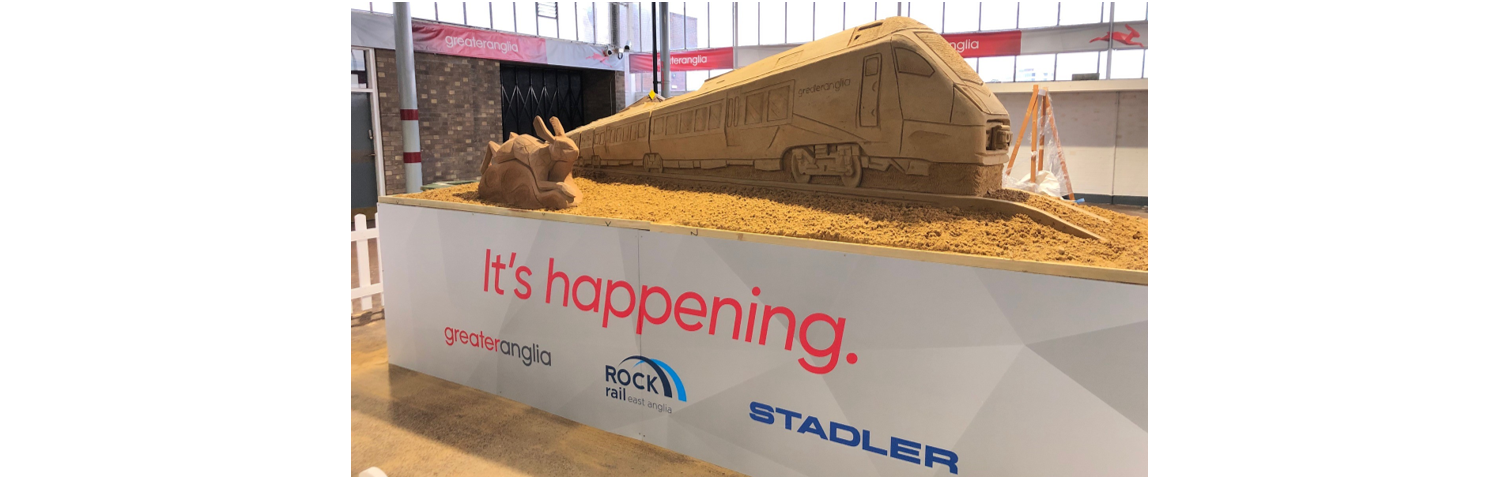
Sand sculpture on display at Great Yarmouth station

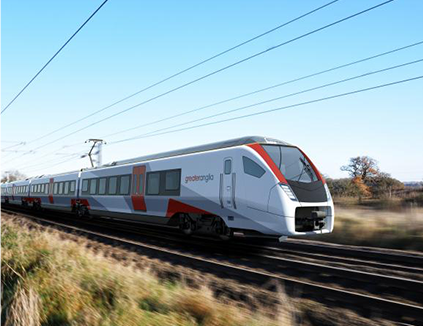
The sculpture represents one of 38 new bi-mode trains financed by Rock Rail East Anglia, a joint venture between Rock Rail, Aberdeen Standard Investments and GLIL Infrastructure, and made by Swiss manufacturer Stadler for Greater Anglia.

It shows the train alongside a leaping hare, Greater Anglia’s new brand symbol and took three days to build.

It coincides with the first of the new bi-mode trains, which run on electricity and diesel, going into passenger service on the route between Norwich, Great Yarmouth and Lowestoft last week.

Sand in Your Eye, which worked with Danny Boyle to create 32 sand drawings on beaches across the UK in the Pages of the Sea project commemorating the First World War, created the sculpture.

Two artists, Richard Spence and Jamie Wardley, who between them have been sand carving for 17 years, used two tonnes of sand in the middle of Great Yarmouth station concourse while holidaymakers looked on.

They compacted the sand in wooden shuttering, mixed it with water and compacted it. Then they removed the shuttering to reveal a soft sand stone and carved using shovels, building trowels and pallet knives.

David Metherell, Greater Anglia Head of Commercial Development, said: “It’s a busy time of year at Great Yarmouth station and we’re really pleased that we’ve been able to start to introduce our new trains on this route.

“Our new trains are longer with more space for holidaymakers and their luggage and they should also increase reliability on this route, which we know is very important for our customers.

“The sand sculpture gives the station an added buzz and adds to the excitement of getting the new trains. Feedback so far has been incredibly positive and we are looking forward to introducing more new trains in the region soon.”

Richard Spence said: “It was lovely to be able to visit Great Yarmouth and make the new Stadler train. The finished sculpture looks excellent and we hope people enjoy looking at it.”

Greater Anglia is replacing all of its trains with brand new trains which are longer with more seats, plug and USB points, free wifi, air conditioning, accessible toilets, and improved passenger information screens.
Recent articles

Rock Rail and Infracapital Partners Back New Battery-Electric Train...

Deal marks a long term investment in the country’s zero emissions transport infrastructure. Rock Rail, a leading developer...

Rock Rail purchases a brand-new fleet of Talent 3...

Rock Rail and abrdn Core Infrastructure have announced an investment in Alstom-built 31 x 6-car Talent 3...

Rock Rail ranked number one for Global ESG performance...

GRESB has named Rock Rail as the top ranked ESG (Environment, Social and Governance) Sector Leader in...

Driving Net Zero: How Rock Road 
Is Funding the UK’s Bus Transition

Accelerating the shift to clean, affordable, zero-emission transport

Year
2025
Category
Rock Road
Share

The Challenge

The UK bus network is at the heart of everyday travel – but over 30,000 diesel buses still need replacing to achieve a fully zero-emission fleet.

While around 5,000 battery-electric buses are already on the road, the high upfront cost of electric vehicles and depot electrification continues to slow the transition. Traditional funding routes — such as government grants or short-term bank finance – have helped start the journey but cannot support decarbonisation at the scale required.

A new, sustainable funding model was needed: one that could attract long-term capital, spread costs fairly, and give operators and authorities confidence in the future.

The Solution

In 2021, Rock launched Rock Road to deliver exactly that –  applying its proven infrastructure financing approach from the rail sector to the UK’s clean bus revolution.

Working with Aviva, the National Wealth Fund, and HSBC, Rock created a dedicated investment platform that channels infrastructure-style finance from pension funds and institutional investors directly into zero-emission bus projects.

This model provides:

Impact

The platform has already raised £100 million, with capacity to scale to £1 billion per year over the next decade – providing a consistent source of affordable capital for local authorities and operators.

Rock’s model ensures that the total cost of ownership (TCO) of electric buses can now be lower than diesel equivalents, thanks to both cheaper long-term finance and reduced operating costs.

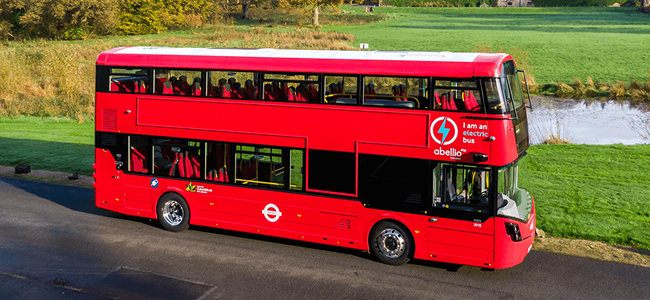
In London, Rock has financed 120 zero-emission buses under 7-year leases aligned with Transport for London’s contract lengths. This structure gives operators flexibility and certainty:

The Future

Rock Road’s ambition is to support the rollout of zero-emission fleets across the UK – helping local authorities and operators meet climate goals without overextending public budgets.

By leveraging limited government funding to attract large-scale private capital – for example, £10 million of public investment unlocking over £250 million in total funding – Rock’s model accelerates decarbonisation while keeping costs low for the public sector.

Our ambition is to make electric buses the default choice - not because of subsidy, but because they are the best economic and environmental option.
Louis Swindell
Commercial Director, Rock Road